For traders
Trade on a desk that has already set aside your maximum payout
You join a desk by invitation from someone you know. Before your order fills, the desk's reserve for your best-case profit is locked. You trade at an index price nobody at the desk can move, and you can check the reserve at any time.
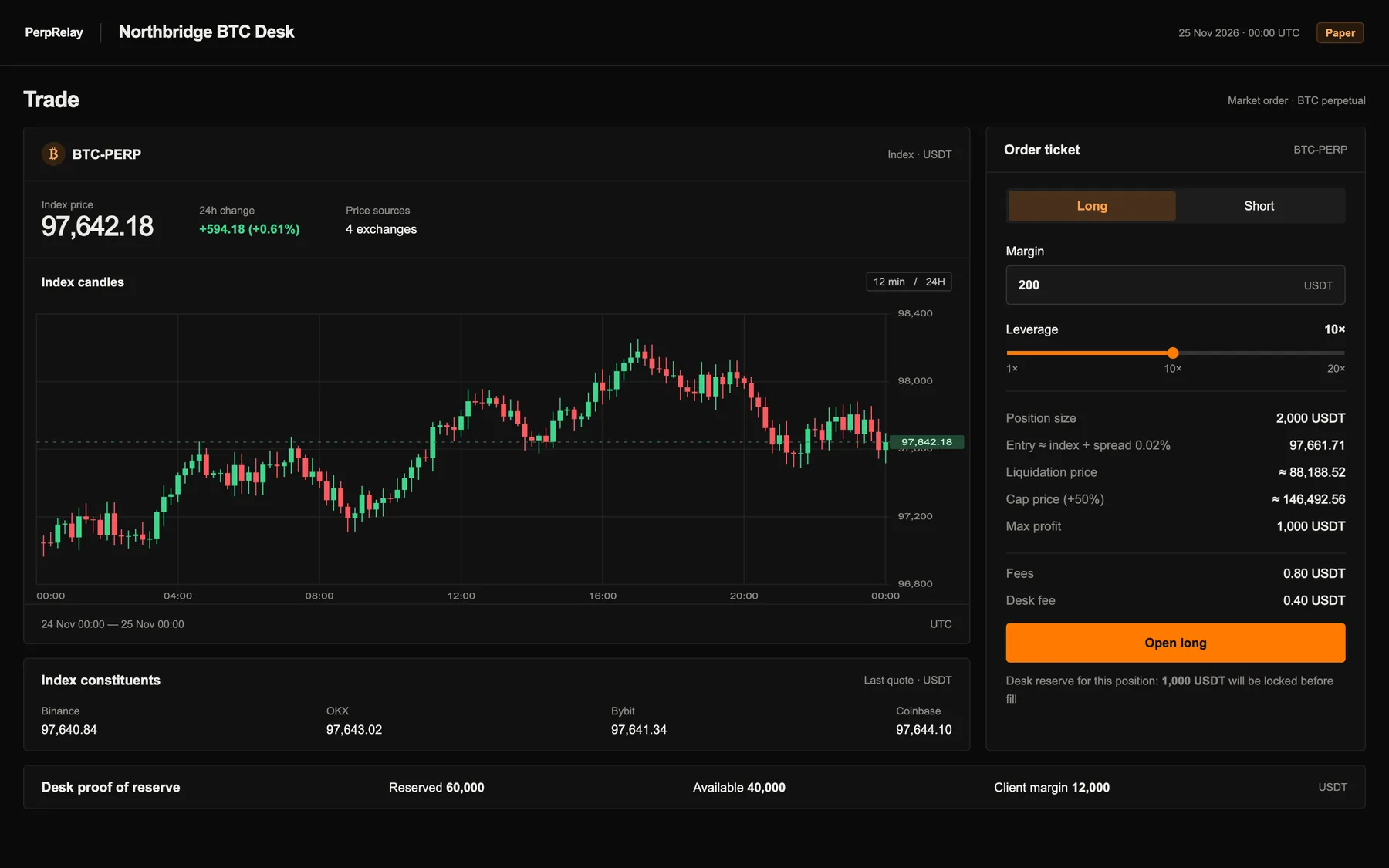
Order ticket
What you see before you confirm an order
| Field | Example | What it means |
|---|---|---|
| Margin | 200 USDT | The most you can lose on this position |
| Leverage | 10× | Position size 2,000 USDT. Up to 20× in the paper program; the desk may set a lower limit |
| Entry price | Index + desk spread | The spread is published by the desk before you trade |
| Liquidation price | About 9–10% against you at 10× | Where the position closes if your margin runs out |
| Payout cap | 1,000 USDT profit | 5× margin. At the cap the position closes automatically and pays in full |
| Cap price | About 50% in your favour at 10× | The index level where the cap is reached |
| Fees | Platform fee + desk fee, shown separately | Charged on open and on close |
Numbers are illustrative. How the cap price relates to leverage is explained in How capped-payout perps keep a desk solvent.

Three things you can check yourself
Trust the numbers, not the promise.
01
The desk's reserve

Every desk shows its proof of reserve: total reserved for open positions, available reserve and total client margin. If the desk cannot cover a new position, the order is refused rather than filled on credit.
02
The price

The mark price is the median of spot prices from several large exchanges. If feeds fail, new positions pause. Why an index price is fairer.
03
Your record

Every fill, liquidation and cap-out stores the index value, each source quote and a timestamp. Export it whenever you want.
How your positions can close
- You close it at index plus spread.
- Your stop-loss or take-profit triggers on the index price, not on a spike at one exchange.
- Liquidation if losses use up your margin. You lose that margin and nothing more.
- Payout cap when profit reaches 5× your margin. The position closes and pays the full reserved amount.
The complete flow, with a diagram, is on How it works.
Capped Perpetuals vs exchange perpetuals
A position on a PerpRelay desk is a capped perpetual: it behaves like the perpetual futures you know from exchanges, except that its profit stops at a cap fixed when you open it, and it closes automatically there. The full comparison is on the home page.
- Most you can lose: your margin, as on an exchange.
- Most you can win: 5× your margin by default, or 3× / 4× if the desk sets a lower cap. Always shown before you confirm.
- What you get for the cap: your maximum payout is already locked by the desk, and nobody can cut a winning position back.
The trade-off, stated plainly
Perpetual futures are leveraged. Most of the time, leveraged traders lose money, and you can lose your whole margin quickly. On PerpRelay your profit per position also has a ceiling. In return, the desk cannot fail to pay you up to that ceiling. Read the risk disclosure before you trade.
If you are new to perpetuals, start with What is a perpetual futures trading desk and how desk models differ.
What a desk cannot do to you
- Change your fill price or edit a fill after the fact.
- Hold or delay a withdrawal of your free balance.
- Trade against you from a linked account. Linked accounts are blocked.
- Open new positions for you without reserve to back them.
These rules are enforced by the platform, not by promise. See the six rules and the terms.
Questions people ask
Why is my profit capped?
How do I join a desk?
Can I lose more than my margin?
Can the desk change my fill price?
Is this available where I live?
Got an invite already? The desk owner will send your link. Running a community yourself? See desk owners or apply as a founding desk. More answers in the FAQ; pricing is on the pricing page; the stages ahead are on the roadmap, and who builds PerpRelay is on the about page.

Ready to run a desk you can prove?
Set up a full desk on paper: your markets, your limits, your clients, and a reserve your clients can check.